(Last updated 19 July 2024)
Building and testing eDNA resources for Illinois fishes
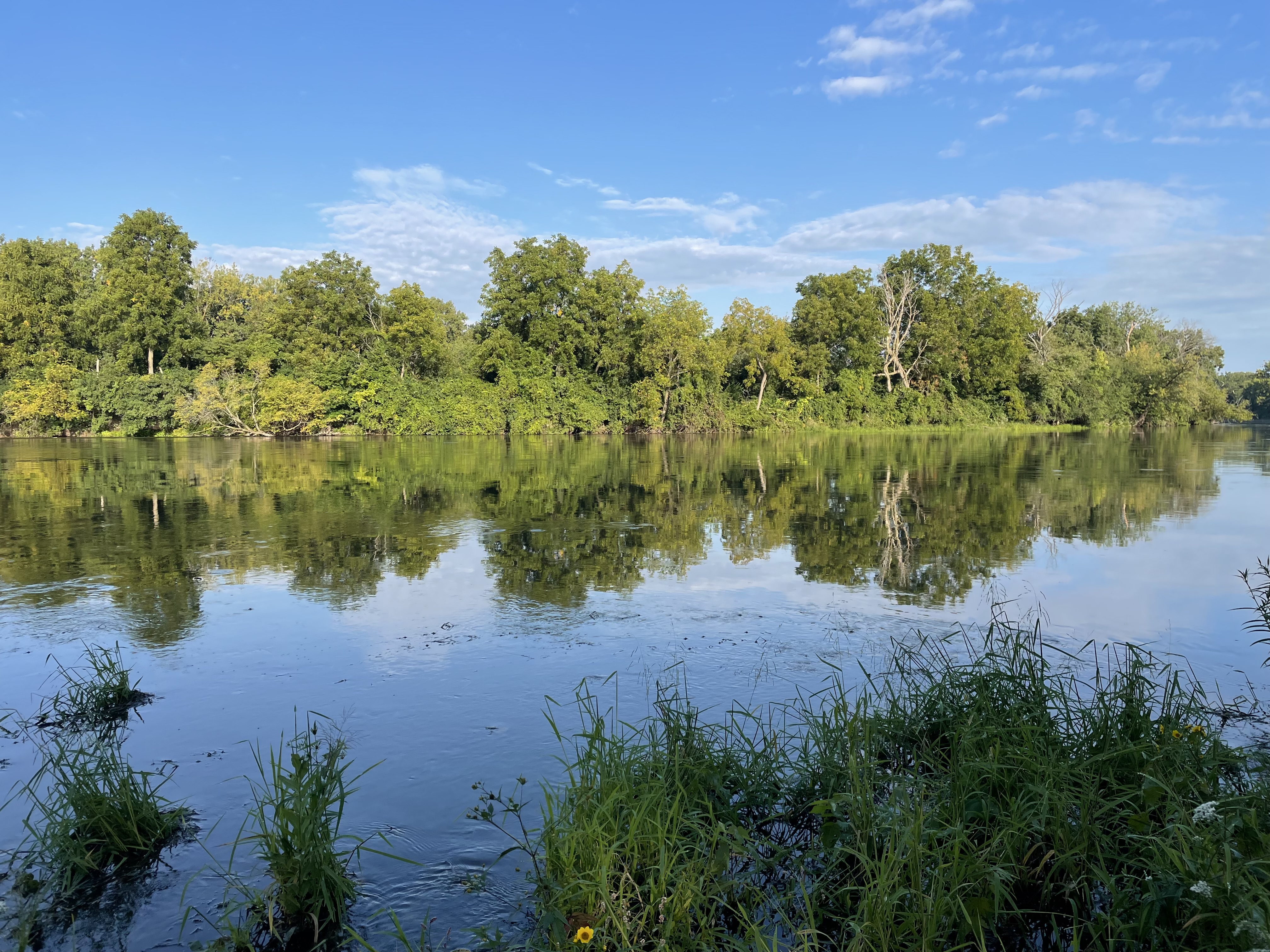
Background and Ongoing Work: Environmental DNA sequencing (eDNA) is the sequencing of DNA fragments found in environmental samples (air, water, soil). Modern genomic techniques allow us to gather sequence from these samples and then match them against genomic reference databases to determine which organisms left that DNA behind. This species information can then be used for both basic research and applied to conservation and management. However, this approach is only as good as the reference database. If a species isn’t in the database, we can’t detect it. And, most species are missing. With funding from the Walder Foundation Biota Award, we will build complete mitochondrial reference genomes for every fish in Illinois. We will then test this database using metagenomic eDNA approaches in Illinois’s Fox River to capture a snapshot of species diversity in the river, track how diversity changes with land use and human density, and compare our findings to standard sampling approaches. This information and resource should be valuable to researchers and policy makers in Illinois, the Great Lakes, and the Mississippi Basin. This is a multi-disciplinary collaboration with the the Field Museum of Natural History, the University of Illinois Urbana-Champaign, Illinois Department of Natural Resources, the Illinois Natural History Survey, and the Friends of the Fox River. Watch a short video!
Microevolution and Macroevolution in a Fossil Stickleback Lineage

Background and Ongoing Work: A diatomite mine in Fernley Nevada hosts a fossil threespine stickleback lineage (Gasterosteus doryssus) that is is probably one of the best examples of gradual Darwinian evolution in the fossil record. Stickleback were fossilized in annual varves and this deposit spans more than 100,000 years. I am collaborating with Dr. Michael A. Bell, who developed this system (e.g., Bell 1985; Bell et al. 2006; Hunt et al. 2008; Bell 2009) to analyze existing data to infer the genetic basis of armor loss, detect the accumulation of reproductive isolation, understand how sexual dimorphism evolves, and test Fisher’s fundamental theorem. I was also awarded an NSF CAREER award in January 2022 to revisit and further prepare >4500 specimens in the University of California Museum of Paleontology to gather a massively multivariate trait set conducive to questions of microevolutionary rates, evolution of allometry and the P-matrix, and more. Dr. Jacopo Cerasoni is the postdoc leading this work, who has added an excellent paleo-ecological angle to the project! We are also welcoming a new MS student, Laura E. Arias Concha to work with existing samples, studying over 100,000 years of climate change using microfossils and stable isotopes. Project Summary
Selected publications from this work:
Siddiqui, R., S. Swank, A. Ozark, F. Joaquin, M.P. Travis, C.D. McMahan, M.A. Bell, and Y.E. Stuart. 2024. Inferring the evolution of reproductive isolation in a lineage of fossil threespine stickleback, Gasterosteus doryssus. Proceedings of the Royal Society B 291: 20240337. 10.1098/rspb.2024.0337
Cerasoni, J.N., M.A. Bell, and Y.E. Stuart. 2024. Geology, microstratigraphy, and paleontology of Truckee Formation lacustrine diatomite deposits near Hazen, Nevada, USA, with emphasis on fossil stickleback fish. PaleoBios 41: 1-15. 10.5070/P941161500
Cerasoni, J.N., M.C. O’Toole†, R. Patel†, and Y.E. Stuart. 2023. Miocene phytolith and diatom dataset from 10.3Myo diatomite formation, Fernley, Nevada, USA. Data In Brief 50: 109519. 10.1016/j.dib.2023.109519
Voje, K.L., M.A. Bell, and Y.E. Stuart. 2022. Evolution of static allometry and constraint on evolutionary allometry in a fossil stickleback. J. Evolutionary Biology. 10.1111/jeb.13984
Stuart, Y.E., M.P. Travis, and M.A. Bell. 2020. Inferred genetic architecture underlying evolution in a fossil stickleback lineage. Nature Ecology and Evolution 4: 1549-1557. 10.1038/s41559-020-01287-x
Resurrection Ecology and the Evolutionary Effects of Radiation on Populations

Background and ongoing work. Between 1953 and 1962, the US Department of Energy denotated 100 above ground nuclear weapons as part of a testing program at the Nevada Test Site. Radioactive fallout from these tests covered the globe but was particularly heavy in Utah, Nevada, and Arizona. In new work recently funded by a National Science Foundation EAGER grant, Co-PI Matt Walsh, Cole Thompson, and I are asking about the evolutionary impact of this fallout. In June 2020, we visited 8 alpine lakes in Utah to take sediment cores, with the hopes of reaching sediments that were deposited before, during, and after testing. Next, we will isolate the dormant eggs of the small crustacean Daphnia from those sediments. By hatching those eggs and keeping track of hatch rate, survival, and reproduction, we should be able to measure the fitness effects of radiation on the populations, and how they have evolved in response. Update (Fall 2022): We isolated >4500 ephippia and after quite some effort … only hatched 1! Ironically, it came from sediment samples dated to the 1950s. For whatever reason, ephippia from these populations don’t hatch well using usual Daphnia techniques. If anyone has any ideas, we’d love to hear them! In the meantime, we pivoted to a similar project using ancient DNA from sediment cores to reconstruct evolutionary history of a threespine stickleback species pair from Enos Lake, with Dolph Schluter, Andy Foote, and the Hakai Institute.
Neely-Streit, T., M.C. O’Toole†, M. Islam†, E.M. Ciolak†, C.J. Thompson, A.J. Heathcote, A.L. Masterson, M.R. Walsh, and Y.E. Stuart. 2023. A resurrection ecology test for the effects of ionizing radiation and other environmental correlates on Daphnia evolution. bioRxiv. https://doi.org/10.1101/2023.02.10.524566
(Non)parallel evolution in extant threespine stickleback
Background and Findings: Convergence onto similar phenotypes in similar environments by independent species or populations is strong evidence for evolution by natural selection. Often, evolutionary ecologists focus on those traits that are evolving most in parallel. Multi-trait, quantitative approaches to parallel evolution that ask how much parallelism there is, and why, are more rare. In collaboration with Dan Bolnick, Catherine Peichel and Andrew Hendry, I have studied populations of threespine stickleback adapting to lake and stream environments replicated across 16 different watersheds on Vancouver Island, BC, Canada. We found that the extent of parallel evolution depended strongly on which trait was being investigated. Deviations from parallel evolution of lake-stream divergence, and depended on watershed specific differences in environment and lake-stream gene flow. This suggests that evolution is not parallel, but can still be predictable if we know enough about the system.
Ongoing Work: Dan Bolnick, Catherine Peichel, and I are currently experimentally investigating (non)parallelism in natural selection, to see if that helps explain non-parallel evolution in morphology. We’re at the ‘lots-of-sequence-data’ stage, and working slowly through the bioinformatics portion of the analysis. Currently, I am collaborating with Marius Roesti, Dan, and Catherine to investigate habitat choice and its genetic basis in lake and stream fish. And Diana Rennison and I have a proposal in preparation for resubmission to study repeatability in marine-stream clines across replicated Vancouver region estuaries.
Selected publications from this work:
Poore, H.A., Y.E. Stuart, D.J. Rennison, M. Roesti, A.P. Hendry, D.I. Bolnick, and C.L. Peichel. 2023. Repeated genetic divergence plays a minor role in repeated phenotypic divergence of lake-stream stickleback. Evolution 77: 110-122. 10.1093/evolut/qpac025
Rennison, D.J., Y.E. Stuart, D.I. Bolnick, and C.L. Peichel. 2019. Ecological factors and morphological traits are associated with repeated genomic differentiation between lake and stream stickleback. Philosophical Transactions of the Royal Society B, 374: 20180241. 10.1098/rstb.2018.0241
Stuart, Y.E., T. Veen, J.N. Weber, D. Hanson, M. Ravinet, B.K. Lohman, *C.J. Thompson, T. Tasneem, A. Doggett, *R. Izen, *N. Ahmed, R.D.H. Barrett, A.P. Hendry, C.L. Peichel, and D.I. Bolnick. 2017. Contrasting effects of environment and genetics generate a continuum of parallel evolution. Nature Ecology and Evolution, 1: 0158. 10.1038/s41559-017-0158
Thompson, C.J., *N.I. Ahmed, T. Veen, C.L. Peichel, A.P. Hendry, D.I. Bolnick, and Y.E. Stuart. 2017. Many-to-one form-to-function mapping weakens parallel morphological evolution. Evolution, 71: 2738-2749. 10.1111/evo.13357
Evolutionary Ecology of Novel Interactions in Anolis lizards
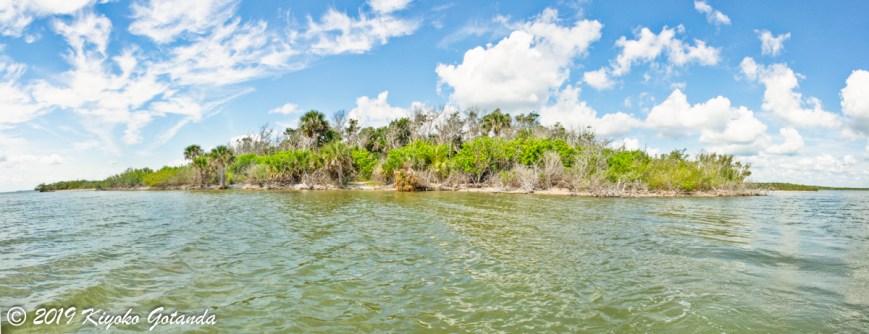
Background and Findings: Stuart’s graduate work tested whether and how the native lizard Anolis carolinensis is responding evolutionarily to the recent invasion of A. sagrei to small spoil islands in Mosquito Lagoon, Florida. Anolis carolinensis naturally occurs on every island in the lagoon. A. sagrei has reached nearly every island. Stuart compared A. carolinensis perch height and toepad morphology on five islands where A. carolinensis was the only anole (the controls) to six islands where A. sagrei had invaded sometime since 1995 (the treatments). Anolis carolinensis perched higher in the presence of A. sagrei and also had larger toepads with more clingy lamellae. This is consistent with toepad morphology across myriad arboreal anole species. A common garden experiment suggests that these toepad differences are evolved. Stuart et al. also also ruled out alternative explanations like chance or environmental differences among treatments.
Ongoing work: With colleagues Ambika Kamath, Nick Herrmann, and Kiyoko Gotanda, we re-started this work in 2019, after finding that one of the five control islands had been invaded by A. sagrei sometime between 2011 and 2018. That paper is published (Kamath et al. 2020). I’ve worked with Douglas Crawford and Marjorie Oleksiak from University of Miami on a genomic analysis of character displacement in this system (Crawford et al. 2023). My graduate student Emmanuel Ezumel has picked up the torch; we spent June 2024 resampling this system–stay tuned!
Anolis carolinensis Anolis sagrei
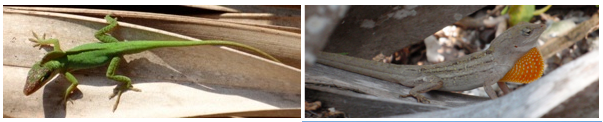
(Lizard photos by C. Gilman)
Selected publications from this work:
Crawford, D.L., al. et Y.E. Stuart and M.F. Oleksiak. 2023. Convergence or redundancy: alternative views about the evolutionary genomics of character displacement. Evolution 77: 1175-1187. 10.1093/evolut/qpad031.
Stuart, Y.E., J.W. Sherwin*, A. Kamath, and T. Veen. 2021. Male and female Anolis carolinensis maintain their dimorphism despite the presence of novel interspecific competition. Evolution. 10.1111/evo.14349
Kamath, A., N.C. Herrmann, K. Gotanda, K.C. Shim, J. LaFond, G. Cottone*†, H. Falkner, T.S. Campbell, and Y.E. Stuart. 2020. Repeated character displacement in the midst of background evolution in island populations of Anolis lizards. Evolution 74: 2250-2264. 10.1111/evo.14079
Stuart, Y.E., T.S. Campbell, P.A. Hohenlohe, R.G. Reynolds, L.J. Revell, and J.B. Losos. 2014. Rapid evolution of a native species following invasion by a congener. Science, 346: 463-466. 10.1126/science.1257008
Stuart, Y.E. and J.B. Losos. 2013. Ecological character displacement: glass half full or half empty? Trends in Ecology and Evolution, 28: 402-408. 10.1016/j.tree.2013.02.014
 Stuart Lab